
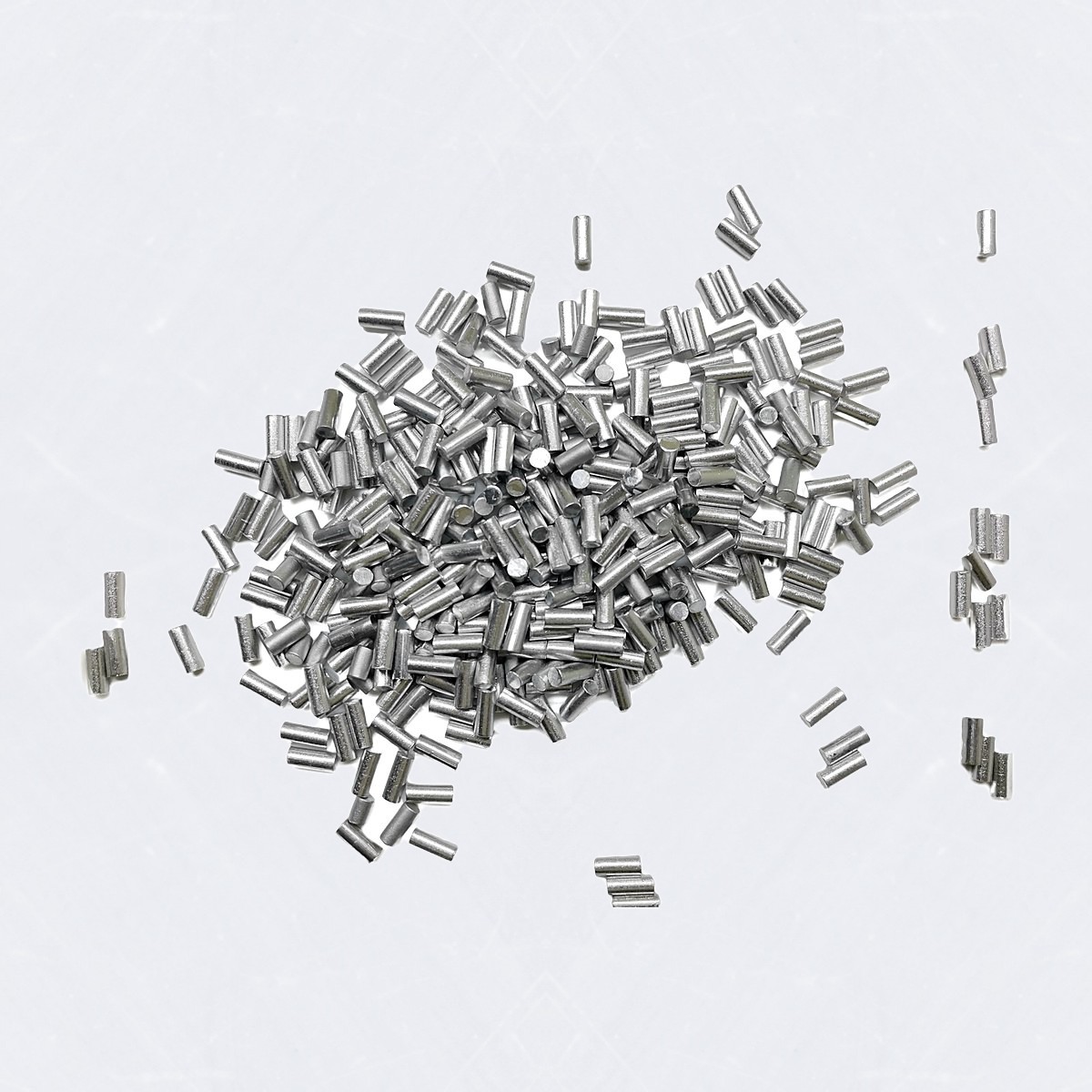
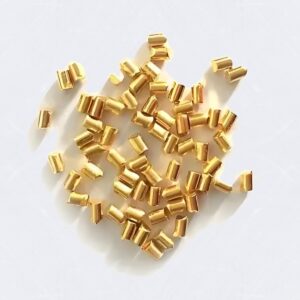
Aluminium evaporation pellets from Shinray Metals: 4N (99.99%) to 5N5 (99.9995%), supplied as pellets, granules or custom preforms for e-beam and thermal evaporation. Aluminium is the cheapest of the high-reflectivity metals and the easiest to evaporate — and the one that most often ruins a run, because it alloys with whatever holds it.
Specification
| Metal | Aluminium (Al) |
|---|---|
| Purity | 4N (99.99%) – 5N5 (99.9995%) |
| Form | Pellets ≈ 3 × 3 mm · granules 1–5 mm · preforms to drawing |
| Density | 2.70 g/cm³ |
| Melting point | 660 °C |
| Evaporation temperature | ≈ 1000–1200 °C |
| Recommended method | e-beam preferred; thermal boats for thin layers only |
| Typical film | Highly reflective, soft, oxidises in air to a thin Al2O3 layer that protects the rest |
| Packing | Vacuum-sealed foil bag, argon flushed; 1 kg per bag, 25 kg per drum |
| MOQ | 1 kg (samples from 100 g) |
| Lead time | 7–15 working days |
Which grade to order
- 4N (99.99%) — decorative and reflective coatings, packaging metallisation, automotive reflectors. Where the film is thick and the substrate is not a device, 4N is enough.
- 5N / 5N5 (99.999% / 99.9995%) — optical coatings, semiconductor metallisation and anywhere the trace impurity level changes film resistivity or creates absorption. 5N5 is the grade we ship most for LED and display work.
The certificate states purity and its basis, so you can compare two suppliers on the same footing — see what 99.99% actually means.
Why aluminium gives trouble in the chamber
Molten aluminium wets almost every liner material, and once it alloys with a graphite or tungsten boat the boat is finished. Three practical rules:
- Use a boron nitride or graphite liner sized so the melt does not climb the wall.
- Ramp the power slowly. The first melt releases adsorbed gas; heating too fast gives the spitting that ends up as particles in the film.
- Keep the level stable. A deep pool convects and spits; a shallow one runs out mid-run. Pellets of uniform size give a predictable melt level.
End applications
- Metallisation of plastics, films and glass (packaging, capacitors)
- Reflective coatings — mirrors, reflectors, decorative trim
- Optical coatings where a UV-to-visible reflector is required
- Semiconductor and display metallisation at 5N and above
Ordering notes
Sizes are adjustable: pellets at 1–6 mm, granules, or arc-cast slugs for a specific liner. Tell us the liner geometry and we can supply material pre-sized to fill it. Standard packing is argon-flushed vacuum foil inside a drum; 1 kg minimum for 4N, 100 g for 5N5 samples.
Frequently asked
Can I evaporate aluminium from a tungsten boat?
You can, once. Aluminium alloys with tungsten and destroys the boat; boron nitride or graphite liners are the practical choice for repeated runs.
Why does my aluminium film look hazy?
Usually oxidation or a high deposition rate at low substrate temperature. Evaporate at the lower end of the rate range and keep the chamber pressure below 10-5 mbar.
Supplied to a Beijing semiconductor equipment maker at roughly 800 kg per year — see the supply case.
Related reading: all high-purity evaporation materials · choosing form, purity and liner
- Applications — where this material is used, by industry.
- Deposition methods — e-beam vs thermal, liner choice, pre-melt and defect fixes.
- Crucible fill calculator — how much charge fits in the liner.
- Film material calculator — material needed for a given thickness.
Reviews
There are no reviews yet.