
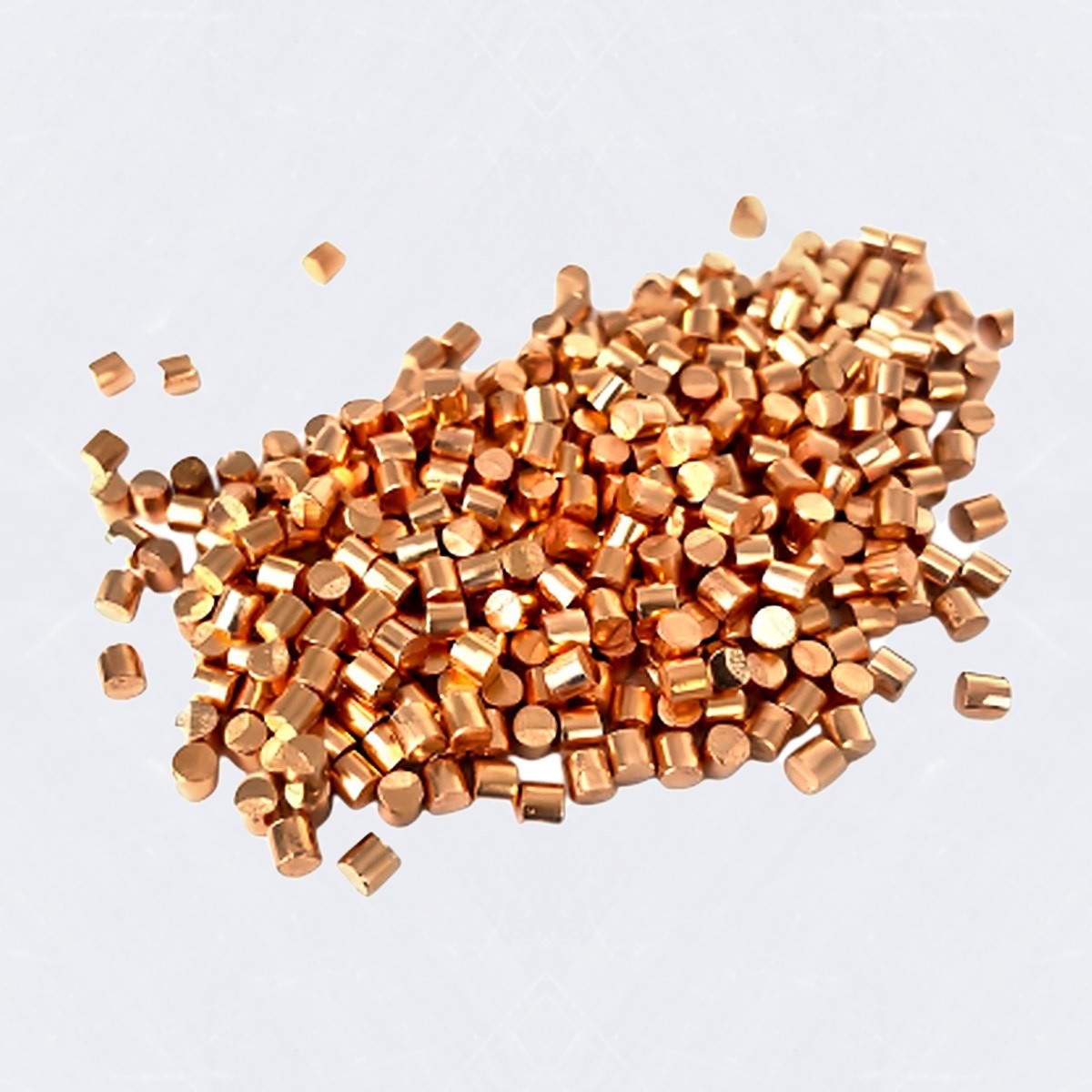
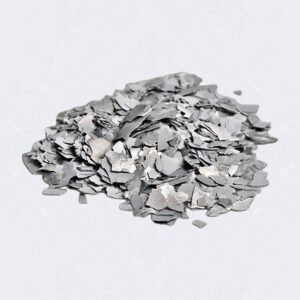
Copper evaporation pellets from Shinray Metals: 4N (99.99%) to 6N (99.9999%), supplied as pellets (≈ 3 × 3 mm), granules or cut pieces for e-beam and thermal evaporation. Copper sits in an awkward position among evaporation metals — high conductivity, moderate melting point, and a strong tendency to pick up oxygen between melt and film.
Specification
| Metal | Copper (Cu) |
|---|---|
| Purity | 4N (99.99%) – 6N (99.9999%) |
| Form | Pellets ≈ 3 × 3 mm · granules 1–5 mm · cut pieces 3–10 mm |
| Density | 8.96 g/cm³ |
| Melting point | 1085 °C |
| Evaporation temperature | ≈ 1300–1500 °C |
| Recommended method | e-beam; thermal boats only for very thin layers |
| Oxygen content | Stated on the certificate — the number that decides film resistivity |
| Packing | Vacuum-sealed foil bag, argon flushed; 1 kg per bag, 25 kg per drum |
| MOQ | 1 kg (samples from 100 g) |
| Lead time | 7–15 working days |
Which grade to order
- 4N (99.99%) — decorative, EMI shielding, general metallisation, thin-film research where the film is not a device layer.
- 5N (99.999%) — interconnects and seed layers; the trace metal level starts to matter for resistivity and for subsequent plating.
- 6N (99.9999%) — semiconductor and quantum-device work, where a few ppm of iron or nickel changes behaviour.
Oxygen is the impurity that matters most for copper: it forms Cu2O, raises resistivity and makes the melt spit. Ask for the oxygen figure rather than the headline purity. Lower grades (3N5) are available on request.
Evaporating copper without spitting
- Pre-melt and degas. Bring the charge up slowly and hold below evaporation temperature until the pressure recovers.
- Do not use a copper hearth without cooling. Copper conducts heat away fast; an uncooled hearth gives an uneven melt and a wandering spot.
- Keep the charge shallow. A deep copper pool is thermally unstable and spits at the centre.
- Store sealed. Copper tarnishes in air; a lot that has been open for months will behave differently from one opened the same week.
End applications
- Interconnects and seed layers in semiconductor and PCB work
- Decorative and antimicrobial PVD coatings
- Metallisation of plastics, textiles and glass
- EMI shielding and flexible electronics
- Sputtering target feedstock
Frequently asked
Does the purity grade change film resistivity?
At 4N the dominant factor is oxygen, not trace metals. Above 5N the metal impurities become the limiting factor. If resistivity is your specification, ask for both the oxygen figure and the metal impurity table.
Can I use the same pellets for e-beam and thermal?
Yes, but thermal boats need smaller charges and suffer more from spitting; most production lines use e-beam for copper.
Related reading: all high-purity evaporation materials · choosing form, purity and liner
- Applications — where this material is used, by industry.
- Deposition methods — e-beam vs thermal, liner choice, pre-melt and defect fixes.
- Crucible fill calculator — how much charge fits in the liner.
- Film material calculator — material needed for a given thickness.
Reviews
There are no reviews yet.