
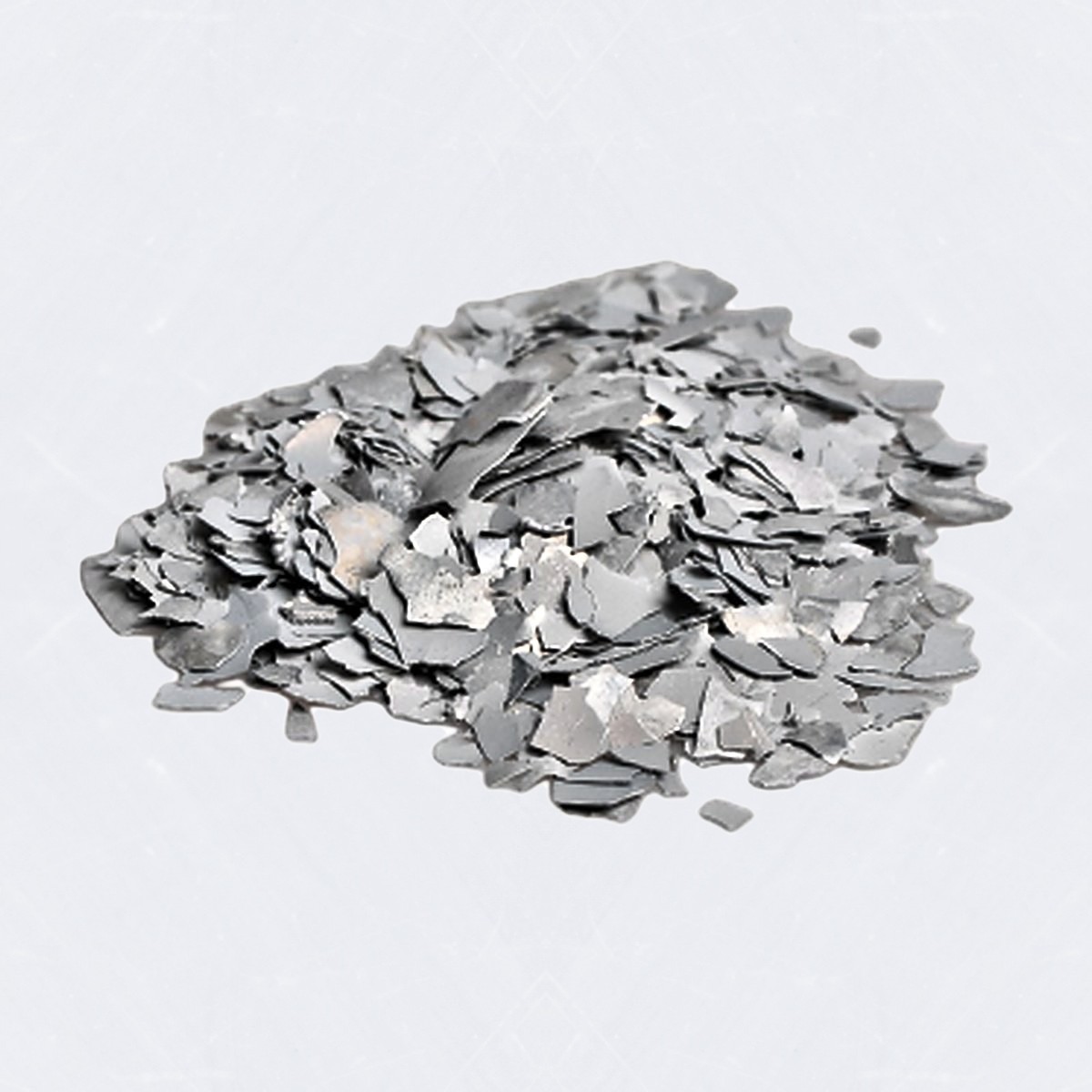
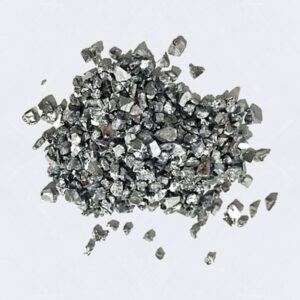
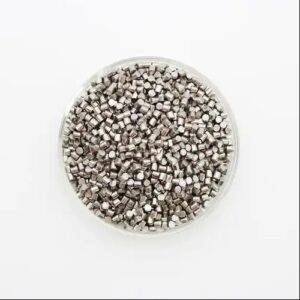
Chromium pieces are the economical form for large evaporation charges: broken or cut material rather than sized granules. The trade-off is a less even first melt, which matters more for chromium than for most metals because of its gettering behaviour.
Specification
| Material | Chromium (Cr) |
|---|---|
| Purity | 3N – 4N5 |
| Melting point | 1907 °C |
| Density | 7.19 g/cm³ |
| Form | Pellets, granules or pieces; custom preforms to drawing |
| Packing | Vacuum-sealed, argon flushed; 1 kg per bag |
| MOQ | 100 g (samples from 10 g) |
| Lead time | 10–20 working days |
Evaporation notes
- Pieces vary in size — expect a slower, less even first melt than with granules.
- Pre-melt patiently; chromium will spit if the charge is heated too quickly.
- For precision optical runs, granules are the safer choice.
End applications
- Bulk adhesion-layer deposition
- Decorative coating on large parts
- Wear-resistant films
- Cost-sensitive production runs
Frequently asked
Why are pieces cheaper than granules?
They are a by-product of cutting and crushing rather than a sized product. The saving is real but the melt is less predictable.
Can I mix pieces and granules?
You can, but the melt behaviour becomes harder to reproduce. Most lines standardise on one form.
Related reading: e-beam evaporation materials guide · all high-purity evaporation materials
Related resources
- Applications — where this material is used, by industry.
- Deposition methods — e-beam vs thermal, liner choice, pre-melt and defect fixes.
- Crucible fill calculator — how much charge fits in the liner.
- Film material calculator — material needed for a given thickness.
Reviews
There are no reviews yet.