
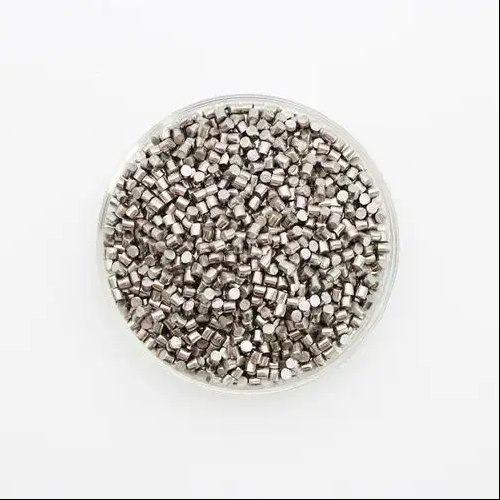
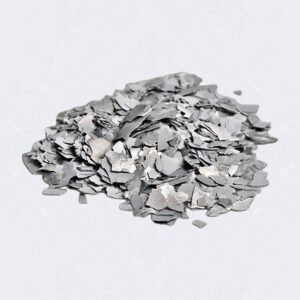
Titanium evaporation pellets from Shinray Metals: 2N4 (99.94%) up to 4N5 (99.995%), supplied as pellets, granules or preforms for e-beam evaporation. Titanium is a getter — it reacts with oxygen, nitrogen and the crucible — so the grade you choose and the way you degas decide whether the film is a clean adhesion layer or a brown, oxygen-rich one.
Specification
| Metal | Titanium (Ti) |
|---|---|
| Purity | 2N4 (99.94%) – 4N5 (99.995%) · highest grade 4N5 |
| Form | Pellets ≈ 3 × 3 mm · granules 1–5 mm · preforms to drawing |
| Density | 4.51 g/cm³ |
| Melting point | 1668 °C |
| Evaporation temperature | ≈ 1800–2000 °C |
| Recommended method | e-beam only; thermal boats are not practical at this temperature |
| Packing | Vacuum-sealed foil bag, argon flushed; 1 kg per bag |
| MOQ | 1 kg (samples from 100 g) |
| Lead time | 10–20 working days |
Which grade to order
- 2N4–3N — decorative and wear coatings, getter films, general metallisation where cost dominates.
- 3N5–4N — optical and adhesion layers; lower oxygen gives a brighter, more consistent film.
- 4N5 (99.995%) — our top grade, for semiconductor and precision optical work where gas content is specified.
Note that titanium is supplied by gas content as much as by purity: a 4N5 lot with high oxygen behaves worse than a clean 4N lot. Ask for the O, N and H figures.
Evaporating titanium
- Pre-melt slowly. Titanium absorbs gas at temperature; the first melt must be given time to degas before the shutter opens.
- Water-cooled copper hearth only. Titanium reacts with graphite and with most ceramics at evaporation temperature.
- Do not let the melt sit. A long dwell gives the getter time to pull residual gas from the chamber and incorporate it into the film.
- Film appearance tells you a lot. A brown or grey film usually means oxidation or a very thin layer; a clean metallic film at 20–50 nm is what an adhesion layer should look like.
End applications
- Adhesion layers under gold or platinum in semiconductor and MEMS work
- Decorative and wear-resistant PVD coatings
- Optical coatings and mirror layers
- Getter films in vacuum devices
- Corrosion-resistant metallisation
Frequently asked
Why is my titanium film brown?
Almost always oxygen — either from the residual chamber atmosphere or from a charge that was not degassed. Pre-melt, keep the base pressure low, and open the shutter only once the rate is stable.
Is 4N5 the highest grade you supply?
Yes. 4N5 (99.995%) is the top of our titanium range; the gas content is stated on the certificate.
Related reading: all high-purity evaporation materials · purity grades explained
- Applications — where this material is used, by industry.
- Deposition methods — e-beam vs thermal, liner choice, pre-melt and defect fixes.
- Crucible fill calculator — how much charge fits in the liner.
- Film material calculator — material needed for a given thickness.
Reviews
There are no reviews yet.