
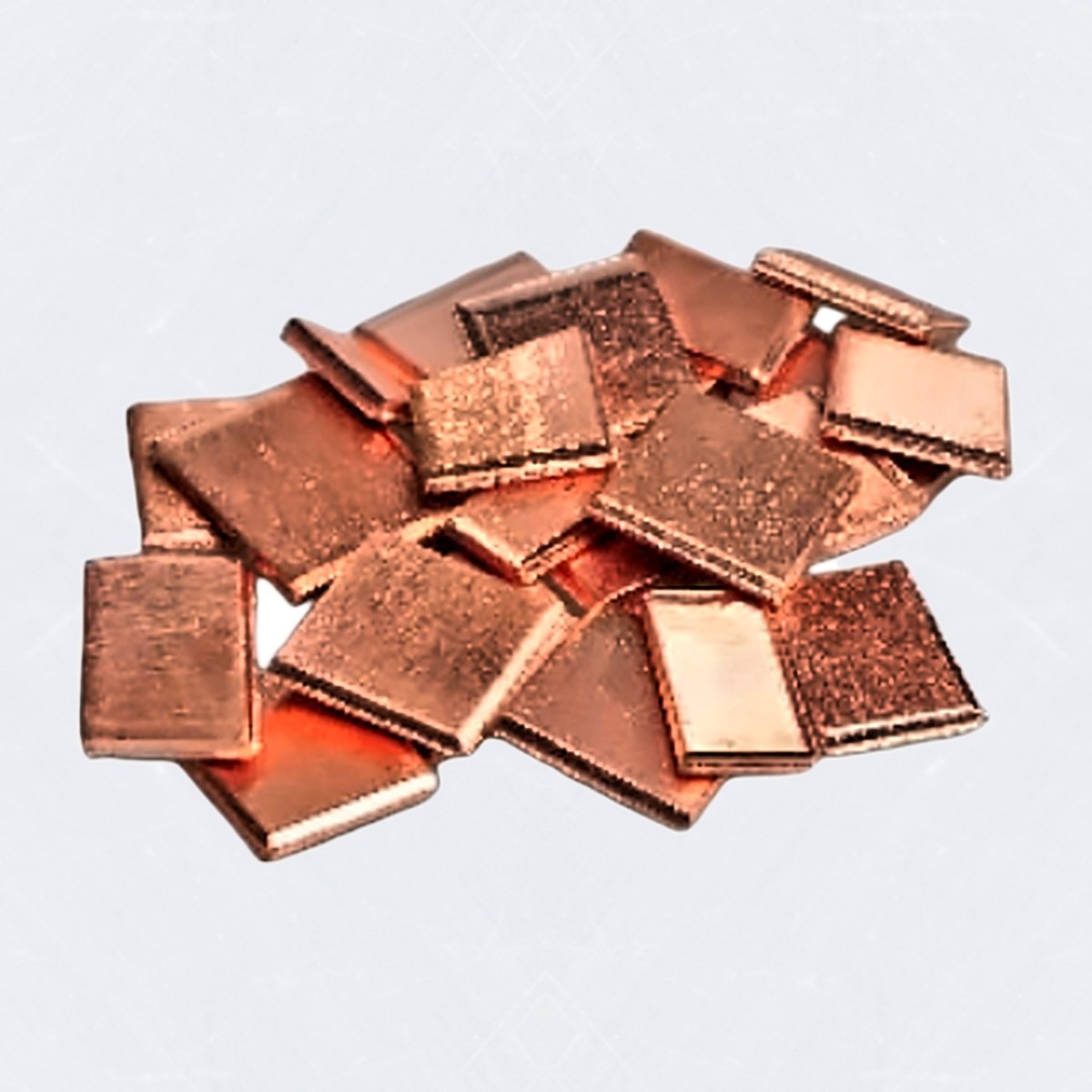
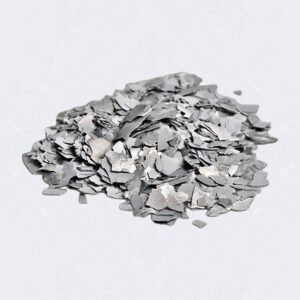
Copper pieces are the economical charge form for e-beam evaporation: cut material that fills a liner without the cost of pressed pellets. For copper, where oxygen pickup is the main impurity risk, the piece size affects how quickly the charge degasses.
Specification
| Material | Copper (Cu) |
|---|---|
| Purity | 3N5 – 6N |
| Melting point | 1085 °C |
| Density | 8.96 g/cm³ |
| Form | Pellets, granules or pieces; custom preforms to drawing |
| Packing | Vacuum-sealed, argon flushed; 1 kg per bag |
| MOQ | 100 g (samples from 10 g) |
| Lead time | 10–20 working days |
Evaporation notes
- Pieces degas more slowly than pellets — allow a longer pre-melt.
- Oxygen content, not the metal total, decides film resistivity; ask for it.
- Store sealed; copper tarnishes in air and tarnish changes first-melt behaviour.
End applications
- Interconnect and seed layers
- Decorative and antimicrobial films
- EMI shielding
- Sputtering target feedstock
Frequently asked
Pieces or pellets for copper?
Pieces are cheaper per kg; pellets give a more repeatable melt. For production runs most lines standardise on pellets.
What purity range is available?
3N5 to 6N; 6N for semiconductor work with a GDAS certificate.
Related reading: e-beam evaporation materials guide · all high-purity evaporation materials
Related resources
- Applications — where this material is used, by industry.
- Deposition methods — e-beam vs thermal, liner choice, pre-melt and defect fixes.
- Crucible fill calculator — how much charge fits in the liner.
- Film material calculator — material needed for a given thickness.
Reviews
There are no reviews yet.