
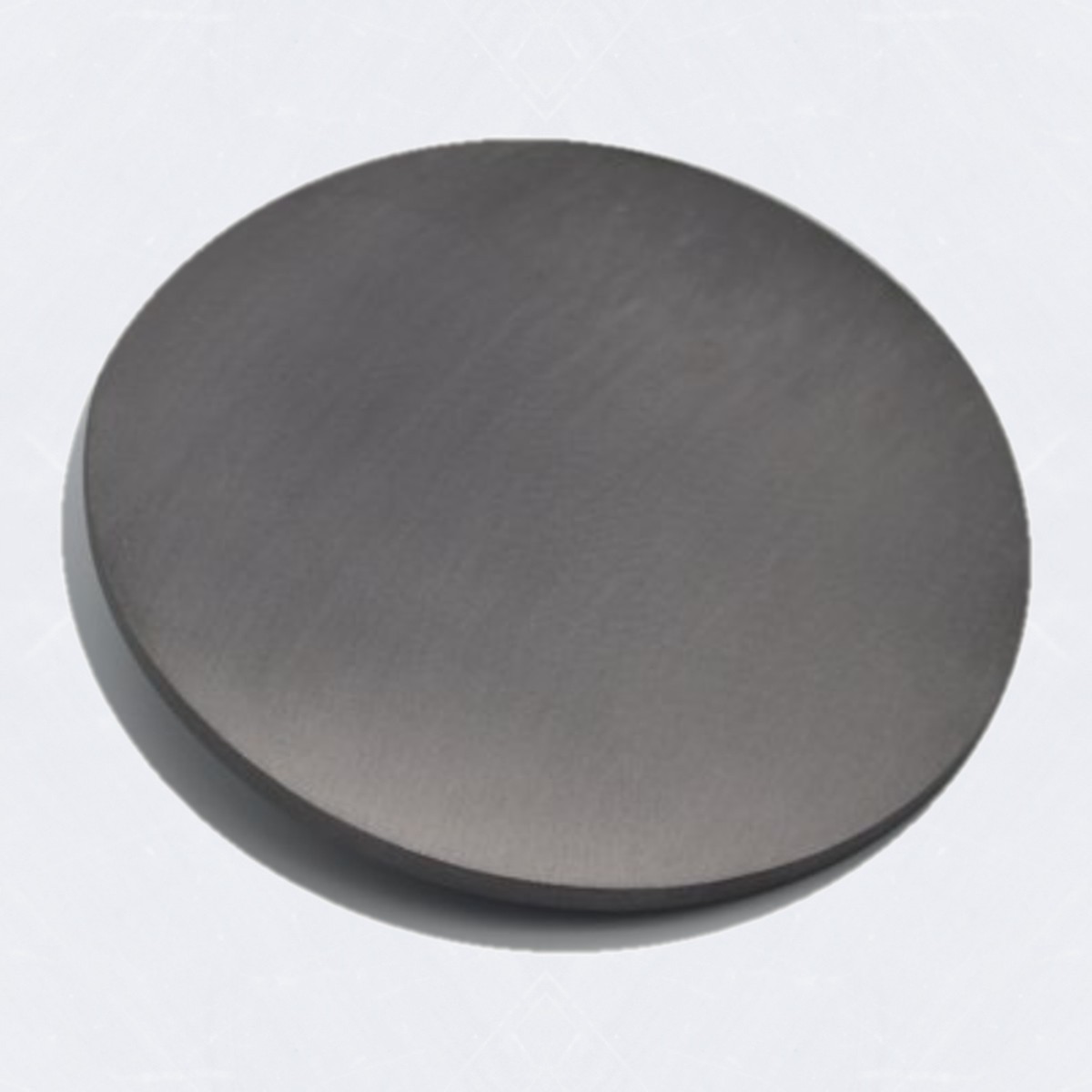
Magnetite targets deposit the conductive, ferrimagnetic iron oxide used in spintronics, magnetic tunnel junctions and electrode applications. Unlike hematite it conducts, which is why it appears as an electrode rather than an insulator.
Specification
| Composition | Fe3O4 (magnetite) |
|---|---|
| Purity | 99.9% |
| Density | 5.17 g/cm³ |
| Melting point | 1597 °C |
| Form | Discs 2″, 3″, 4″, 6″, 8″ · plates to drawing · rotatables on request |
| Bonding | Indium or elastomer to Cu backing; bond coverage checked |
| Packing | Vacuum-sealed, foam-lined case with density and stoichiometry report |
| MOQ | 1 pc |
| Lead time | 20–30 working days |
What decides the film
- Fe3O4 is conductive; Fe2O3 is not — the phase is the specification.
- Magnetite oxidises to hematite if the process is oxygen-rich.
- For spintronics, the film must be phase-pure and epitaxial-quality.
End applications
- Spintronic and magnetic tunnel junction layers
- Electrodes and catalysts
- Magnetic nanoparticle research
- Battery anode materials
Frequently asked
How do I avoid oxidising Fe3O4 to Fe2O3?
Keep the oxygen partial pressure low during deposition and cool in vacuum. Starting from a phase-pure target is necessary but not sufficient.
Do you supply Fe3O4 and Fe2O3 separately?
Yes — they are different products with different certificate data.
Related reading: targets for optical coatings · ITO vs AZO vs IGZO · all ceramic targets
Related resources
- Applications — where this material is used, by industry.
- Deposition methods — e-beam vs thermal, liner choice, pre-melt and defect fixes.
- Crucible fill calculator — how much charge fits in the liner.
- Film material calculator — material needed for a given thickness.
Reviews
There are no reviews yet.