
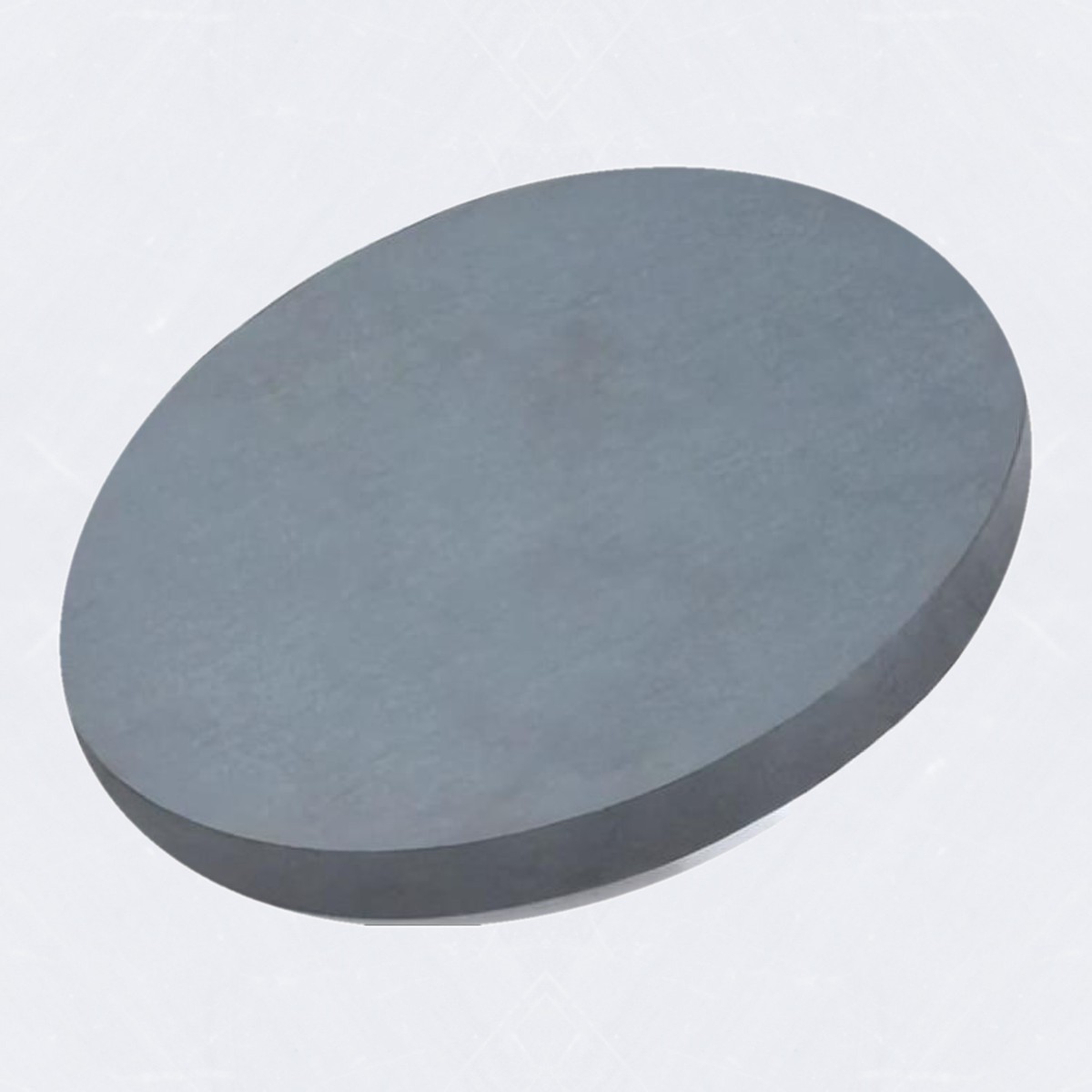
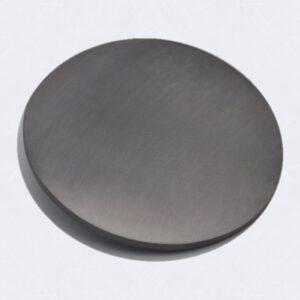
ITO remains the reference transparent conductor: the best combination of sheet resistance and visible transparency, at the cost of indium. Targets are hot-pressed to near-full density because porosity is what causes arcing and particle generation in a production line.
Specification
| Composition | ITO (In2O3/SnO2 90/10 wt%) |
|---|---|
| Purity | 99.99% |
| Density | 7.1 g/cm³ |
| Melting point | ≈1800 °C |
| Form | Discs 2″, 3″, 4″, 6″, 8″ · plates to drawing · rotatables on request |
| Bonding | Indium or elastomer to Cu backing; bond coverage checked |
| Packing | Vacuum-sealed, foam-lined case with density and stoichiometry report |
| MOQ | 1 pc |
| Lead time | 20–30 working days |
What decides the film
- Density above 99% of theoretical is the single biggest factor in particle performance.
- Tin content shifts the carrier concentration — a 1 wt% drift is visible in sheet resistance.
- Bonding is essential for targets above 3 mm; unbonded ITO cracks under thermal load.
End applications
- Touch panels and displays
- Thin-film solar front contacts
- OLED and LCD transparent electrodes
- EMI shielding windows
Frequently asked
Why does my ITO target arc?
Usually porosity, an oxide-rich surface, or a poorly bonded target with hot spots. Density and bond coverage are the two numbers to ask for.
Can you match a specific SnO2 ratio?
Yes — 90/10 wt% is standard, 95/5 and 80/20 are also quoted. The ratio is verified by ICP per lot.
Related reading: targets for optical coatings · ITO vs AZO vs IGZO · all ceramic targets
Related resources
- Applications — where this material is used, by industry.
- Deposition methods — e-beam vs thermal, liner choice, pre-melt and defect fixes.
- Crucible fill calculator — how much charge fits in the liner.
- Film material calculator — material needed for a given thickness.
Reviews
There are no reviews yet.