
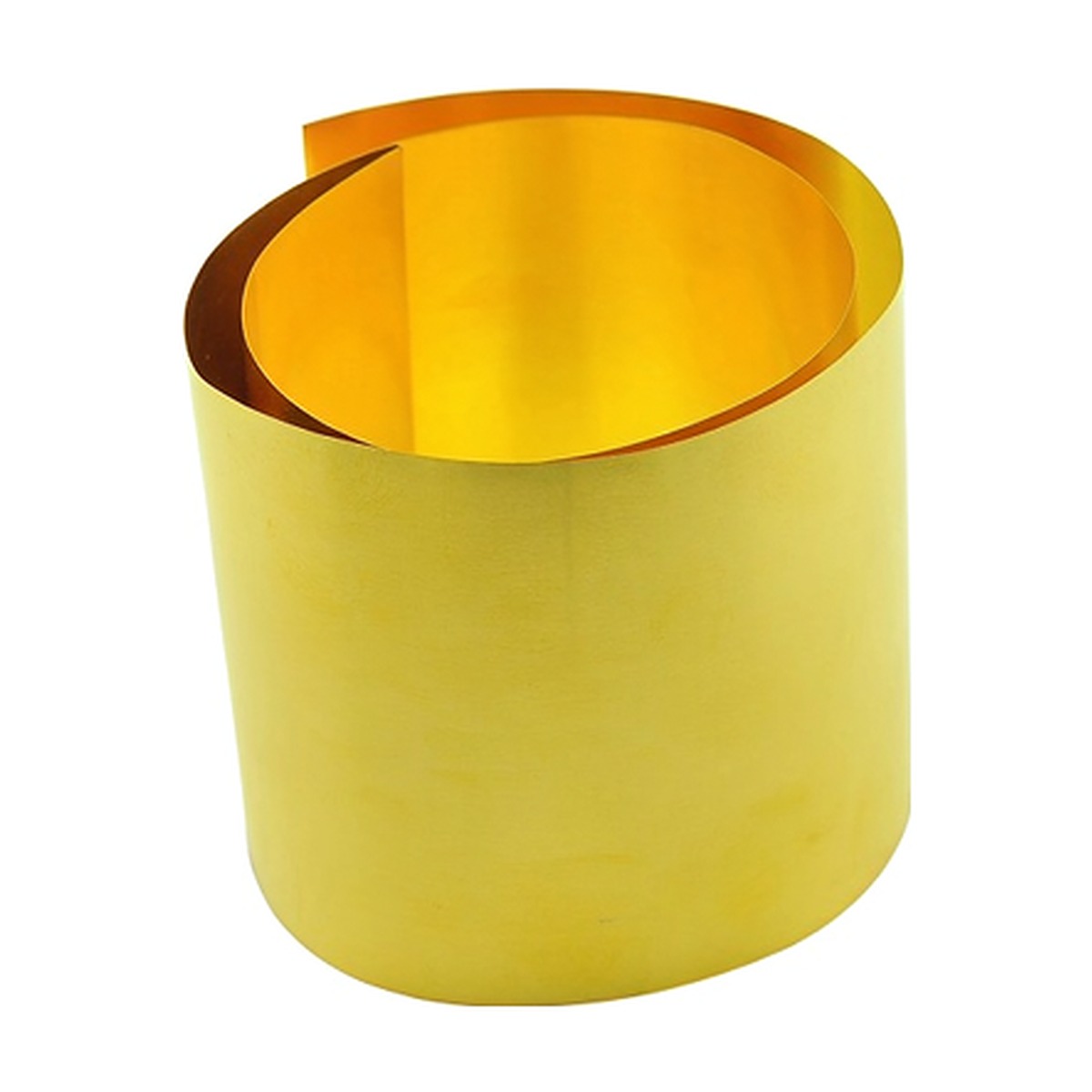
Gold foil in 4N purity from 0.02 mm upward, for vacuum gaskets, evaporation sources and electrical shims. Gold foil does not tarnish, so a gasket keeps its sealing behaviour where a copper one would oxidise and leak.
Specification
| Metal | Gold (Au) |
|---|---|
| Purity | 4N (99.99%) |
| Form | Foil |
| Dimensions | Thickness 0.02–0.5 mm; standard 0.05 / 0.1 / 0.2 mm; width 10–100 mm, coil or cut sheet |
| Density | 19.30 g/cm³ |
| Melting point | 1064 °C |
| Packing | Vacuum-sealed, argon flushed; spool or flat pack in a foam-lined case |
| MOQ | 100 g (samples from 10 g) |
| Lead time | 10–20 working days |
Tolerances and handling
- Thickness tolerance is normally ±10%; tighter on request.
- Foil above 100 mm width is supplied flat-packed, not coiled, to avoid creasing.
- For UHV gaskets, specify the surface finish — a mirror finish seals better than a rolled one.
End applications
- UHV and cryogenic gaskets
- Evaporation source for decorative and optical coatings
- Electrical contact shims
- Sample and reference standards
Frequently asked
Can gold foil be used as a gasket?
Yes, in knife-edge or confined geometries. Gold is soft enough to conform and does not oxidise, which is why it is used in UHV systems.
Do you cut foil to shape?
Yes — laser or die cutting to drawing, quoted against the dimensions and quantity.
Related reading: all wire, foil and solder products · high-purity evaporation materials
Related resources
- Applications — where this material is used, by industry.
- Deposition methods — e-beam vs thermal, liner choice, pre-melt and defect fixes.
- Crucible fill calculator — how much charge fits in the liner.
- Film material calculator — material needed for a given thickness.
Reviews
There are no reviews yet.