
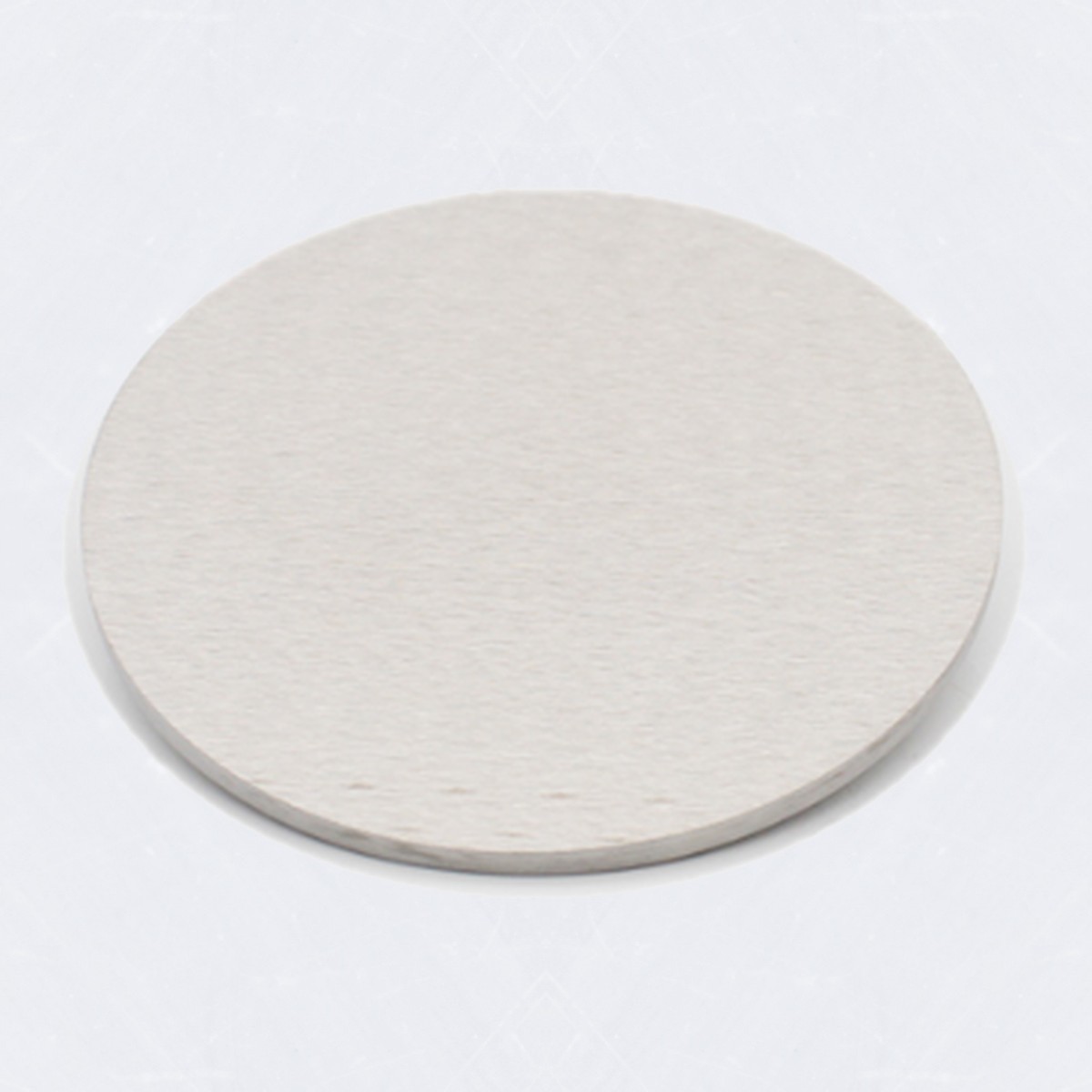
Cobalt targets serve two markets: magnetic films (with Fe and Ni) and, increasingly, cobalt liners and contacts in advanced semiconductor nodes. Purity and magnetic history both matter — a cobalt target that has been exposed to a strong field behaves differently on first use.
Specification
| Material | Cobalt (Co) |
|---|---|
| Purity | 3N5–5N (99.95–99.999%) |
| Density | 8.90 g/cm³ |
| Melting point | 1495 °C |
| Form | Discs 2″, 3″, 4″, 6″, 8″, 12″ · rectangular plates to drawing |
| Grain / texture | Fine grain; stated on request |
| Bonding | Indium or elastomer to Cu / Al backing, bond coverage checked |
| Packing | Vacuum-sealed, foam-lined case with flatness record |
| MOQ | 1 pc |
| Lead time | 15–25 working days |
Sputtering notes
- Ferromagnetic — a magnetically compensated cathode gives a more uniform erosion profile.
- Cobalt oxidises readily; store sealed and degas gently on first melt.
- Iron and nickel are the trace metals to watch in magnetic applications.
End applications
- Magnetic recording and sensor stacks
- Cobalt liners and contacts in semiconductor
- Hard and wear-resistant coatings
- Battery and catalyst research films
Frequently asked
Does the magnetic state of the target matter?
It can. A target magnetised during transport shows a different initial sputter behaviour; most lines demagnetise or run a conditioning step first.
Related reading: target specification guide · all metal sputtering targets
Related resources
- Applications — where this material is used, by industry.
- Deposition methods — e-beam vs thermal, liner choice, pre-melt and defect fixes.
- Crucible fill calculator — how much charge fits in the liner.
- Film material calculator — material needed for a given thickness.
Reviews
There are no reviews yet.