
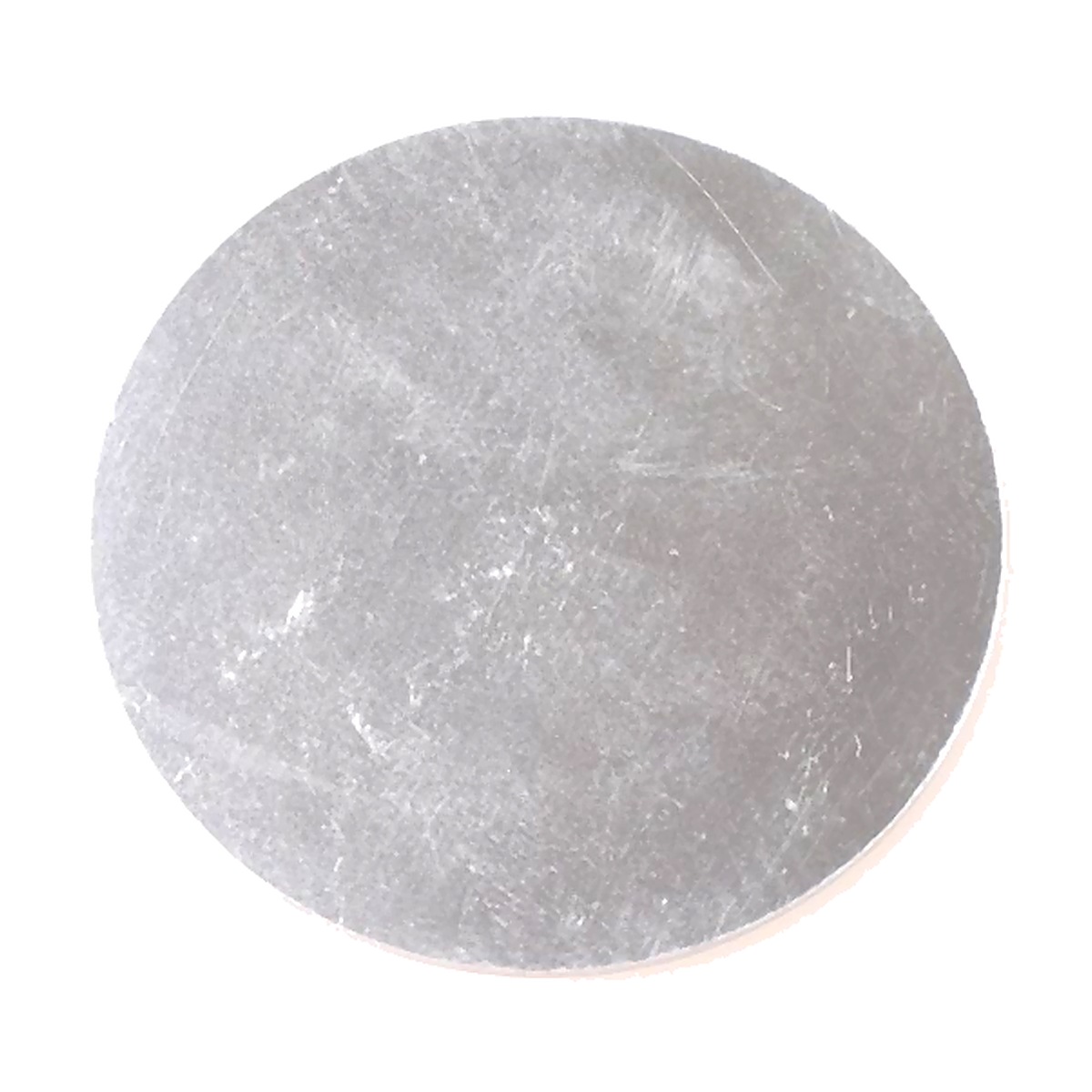
Indium targets melt at 157 °C, which makes them the lowest-melting metal in a typical sputtering catalogue. They are used for indium-containing oxide films, for sealing and bonding layers, and as an alloying source — but the low melting point means the target must be bonded and cooled properly or it will simply flow.
Specification
| Material | Indium (In) |
|---|---|
| Purity | 4N–5N (99.99–99.999%) |
| Density | 7.31 g/cm³ |
| Melting point | 156.6 °C |
| Form | Discs 2″, 3″, 4″, 6″, 8″, 12″ · rectangular plates to drawing |
| Grain / texture | Fine grain; stated on request |
| Bonding | Indium or elastomer to Cu / Al backing, bond coverage checked |
| Packing | Vacuum-sealed, foam-lined case with flatness record |
| MOQ | 1 pc |
| Lead time | 15–25 working days |
Sputtering notes
- Low melting point — bond to a water-cooled backing and control the power density.
- Indium wets many materials; keep a dedicated target if cross-contamination matters.
- For ITO or IGZO, indium metal is normally alloyed in the target rather than sputtered separately.
End applications
- Indium-containing oxide films
- Sealing and bonding layers
- Alloying source for compound films
- Cryogenic and vacuum hardware coatings
Frequently asked
Can an indium target be sputtered without bonding?
Not reliably. At 157 °C the metal softens quickly; a bonded, cooled assembly is required for anything beyond very short runs.
Related reading: target specification guide · all metal sputtering targets
Related resources
- Applications — where this material is used, by industry.
- Deposition methods — e-beam vs thermal, liner choice, pre-melt and defect fixes.
- Crucible fill calculator — how much charge fits in the liner.
- Film material calculator — material needed for a given thickness.


Reviews
There are no reviews yet.