
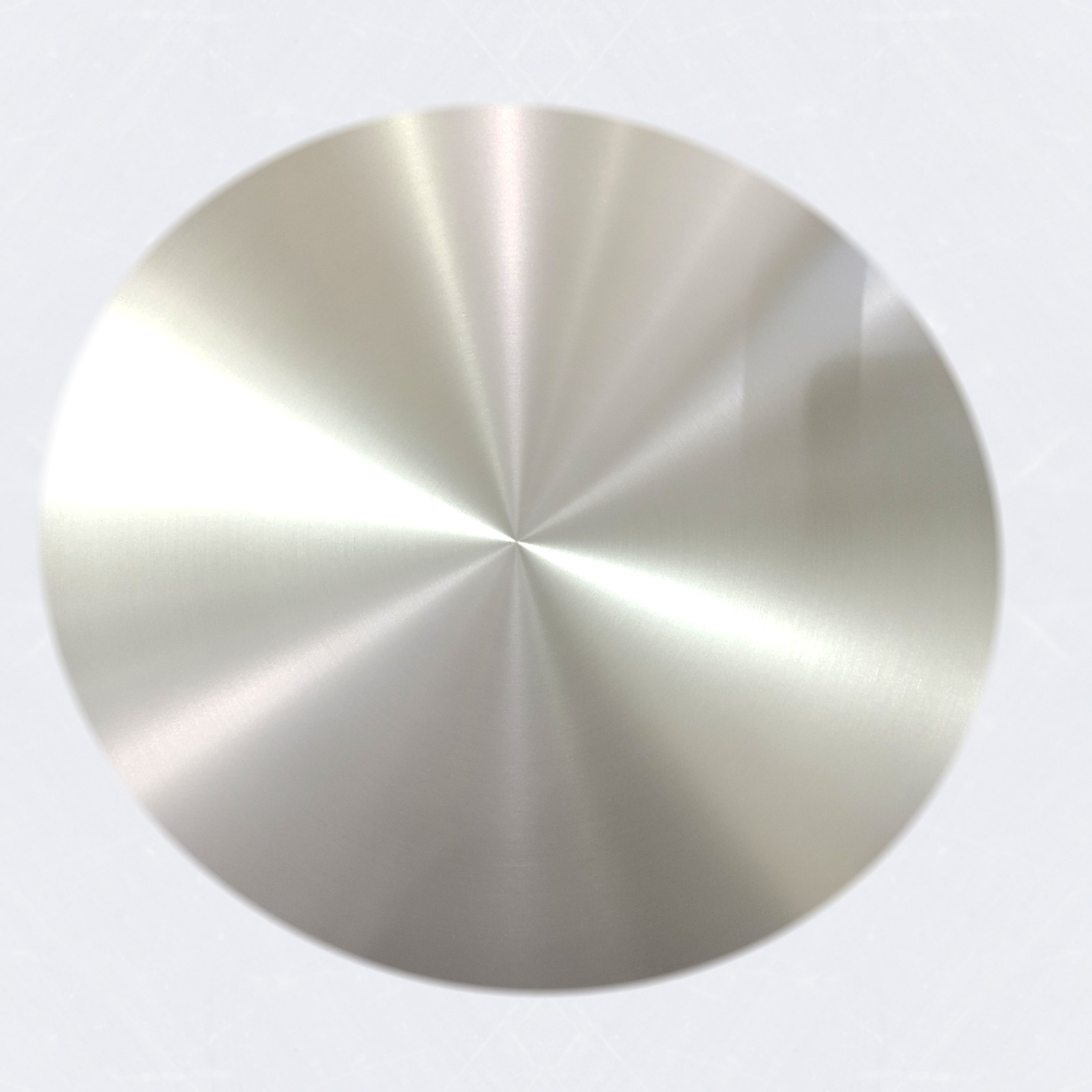
NiCr targets deposit the thin-film resistors used across electronics, and the corrosion-resistant decorative layers where a stainless look is wanted. Resistivity depends on both composition and the oxygen picked up during deposition.
Specification
| Material | Ni/Cr (80/20 wt%) |
|---|---|
| Purity | Ni/Cr 80/20 wt%, ±0.5 wt% |
| Density | ≈8.4 g/cm³ |
| Melting point | ≈1400 °C |
| Form | Discs 2″, 3″, 4″, 6″, 8″, 12″ · rectangular plates to drawing |
| Grain / texture | Fine grain; stated on request |
| Bonding | Indium or elastomer to Cu / Al backing, bond coverage checked |
| Packing | Vacuum-sealed, foam-lined case with flatness record |
| MOQ | 1 pc |
| Lead time | 15–25 working days |
Sputtering notes
- Resistivity is set by composition and by residual oxygen — both need controlling.
- NiCr is ductile and machines well; target life is usually limited by erosion, not cracking.
- For precision resistors, ask for the temperature coefficient data on the film, not just the target assay.
End applications
- Thin-film resistors
- Corrosion-resistant decorative coatings
- Heating elements in thin-film form
- Strain gauges and sensors
Frequently asked
Can I get a specific sheet resistance?
Sheet resistance depends on thickness and process as well as composition. Tell us the target value and the film thickness and we will suggest the composition.
Related reading: target specification guide · all metal sputtering targets
Related resources
- Applications — where this material is used, by industry.
- Deposition methods — e-beam vs thermal, liner choice, pre-melt and defect fixes.
- Crucible fill calculator — how much charge fits in the liner.
- Film material calculator — material needed for a given thickness.
Reviews
There are no reviews yet.