
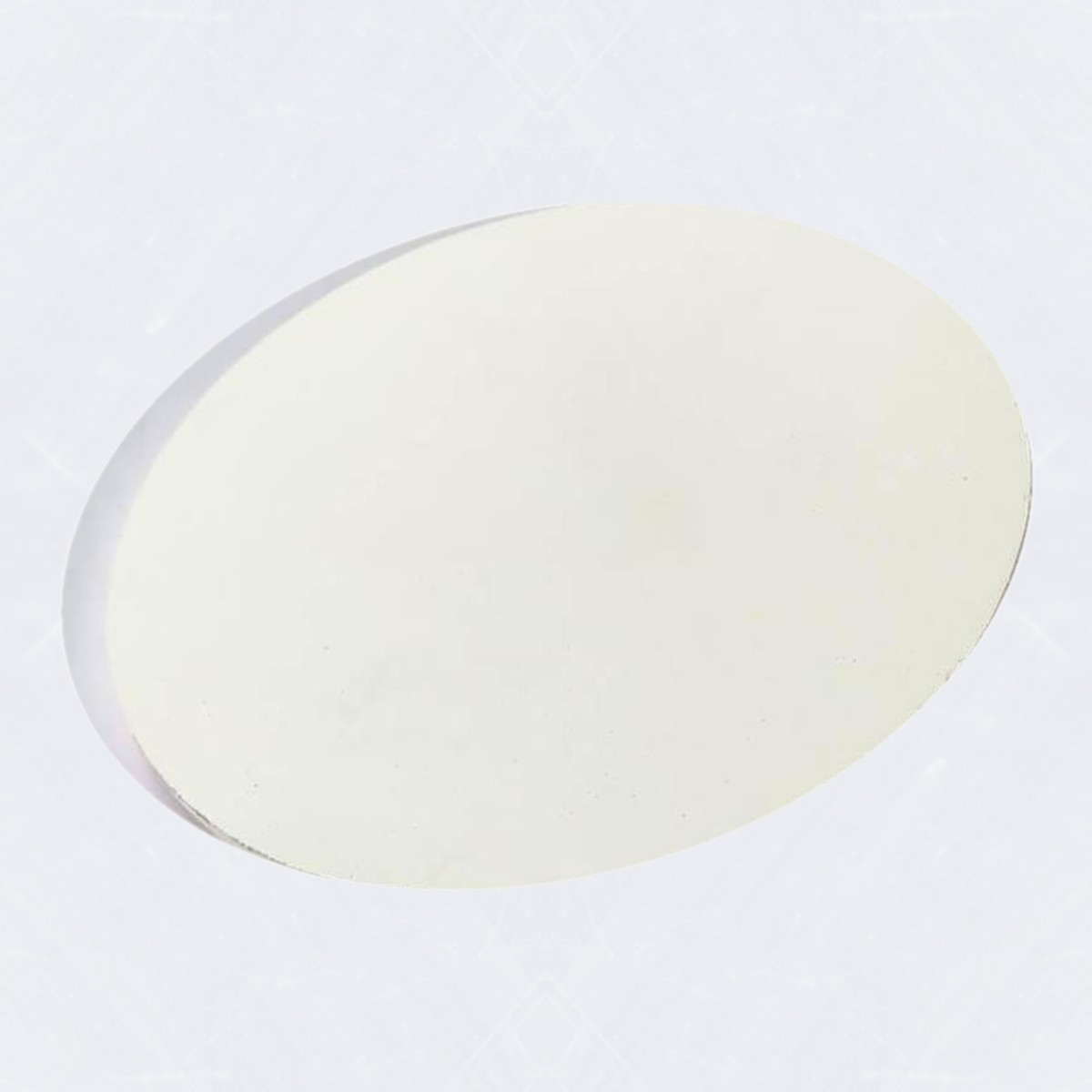
Tantalum pentoxide is the preferred high-index material for precision optical filters: dense, low-scatter and with a wide transmission range. It is also used as a high-k dielectric, where oxygen stoichiometry determines leakage current.
Specification
| Composition | Ta2O5 |
|---|---|
| Purity | 99.9–99.99% |
| Density | 8.20 g/cm³ |
| Melting point | 1872 °C |
| Form | Discs 2″, 3″, 4″, 6″, 8″ · plates to drawing · rotatables on request |
| Bonding | Indium or elastomer to Cu backing; bond coverage checked |
| Packing | Vacuum-sealed, foam-lined case with density and stoichiometry report |
| MOQ | 1 pc |
| Lead time | 20–30 working days |
What decides the film
- Dense targets give low-scatter films — density is a specification, not a detail.
- For high-k use, oxygen vacancies dominate leakage; the target must be stoichiometric.
- Ta2O5 is expensive; utilisation and reclaim are part of the cost.
End applications
- Precision optical filters
- High-k gate and capacitor dielectrics
- Anti-reflection coatings
- Waveguide layers
Frequently asked
Why Ta2O5 rather than TiO2 for filters?
Lower scatter and better laser damage resistance at a similar index. The trade-off is deposition rate and cost.
Do you supply rotatable Ta2O5 targets?
Yes, for high-volume filter lines; quoted against the tool geometry.
Related reading: targets for optical coatings · ITO vs AZO vs IGZO · all ceramic targets
Related resources
- Applications — where this material is used, by industry.
- Deposition methods — e-beam vs thermal, liner choice, pre-melt and defect fixes.
- Crucible fill calculator — how much charge fits in the liner.
- Film material calculator — material needed for a given thickness.
Reviews
There are no reviews yet.