
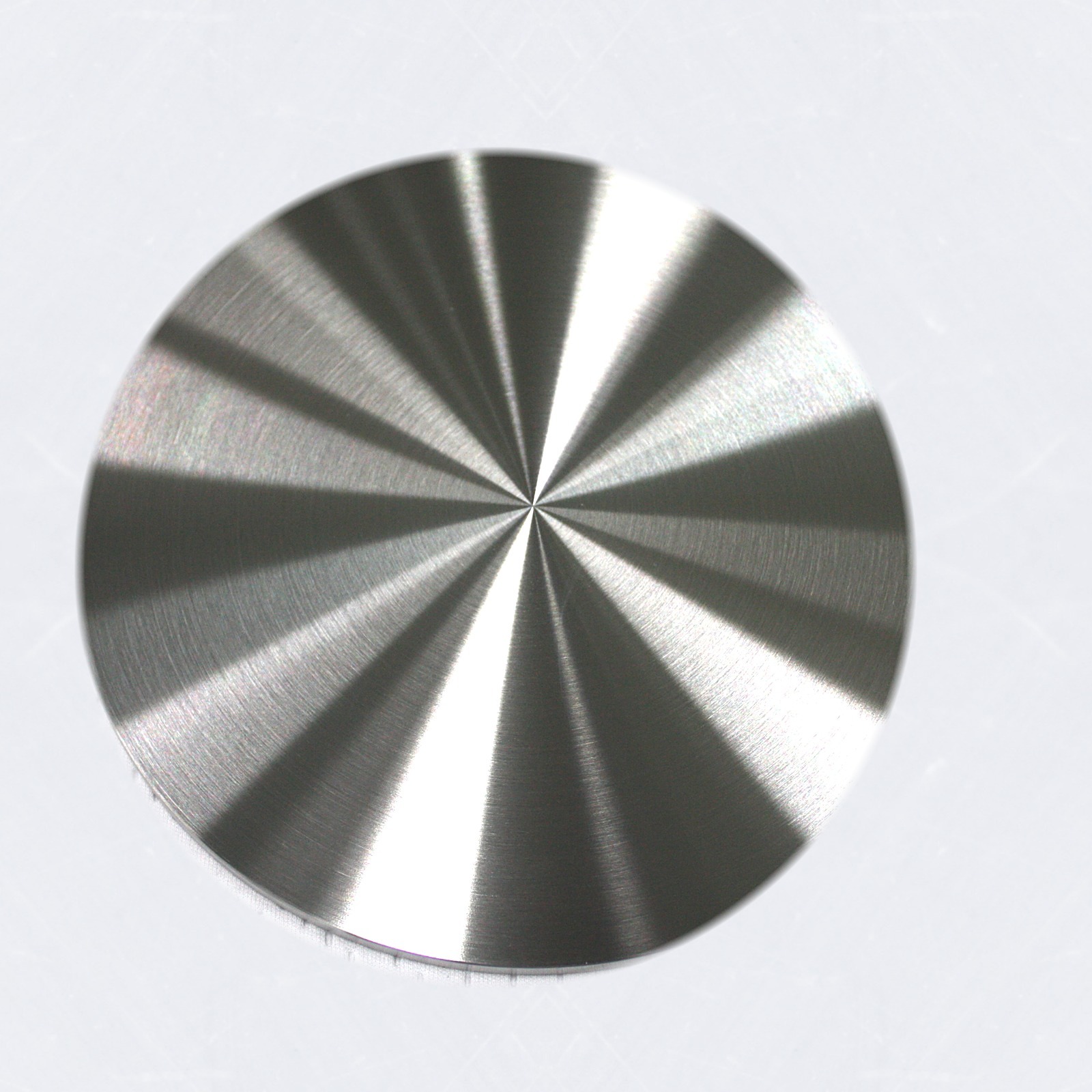
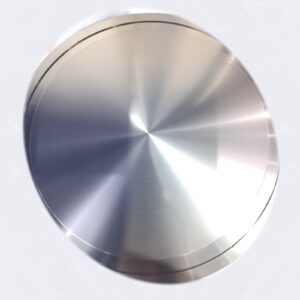
NiV targets are used as a copper diffusion barrier and as a corrosion-resistant layer in electronics. Vanadium addition suppresses nickel diffusion, which is the property the barrier depends on.
Specification
| Material | Ni/V (93/7 wt%) |
|---|---|
| Purity | Ni/V 93/7 wt%, ±0.5 wt% |
| Density | ≈8.6 g/cm³ |
| Melting point | ≈1400 °C |
| Form | Discs 2″, 3″, 4″, 6″, 8″, 12″ · rectangular plates to drawing |
| Grain / texture | Fine grain; stated on request |
| Bonding | Indium or elastomer to Cu / Al backing, bond coverage checked |
| Packing | Vacuum-sealed, foam-lined case with flatness record |
| MOQ | 1 pc |
| Lead time | 15–25 working days |
Sputtering notes
- Vanadium content controls the barrier behaviour — 7% is the common specification.
- Nickel-based targets are ferromagnetic; expect a distorted erosion profile on uncompensated cathodes.
- Bonding recommended above 3 mm.
End applications
- Copper diffusion barriers
- Corrosion-resistant contacts
- Under-bump metallisation
- Magnetic film stacks
Frequently asked
Why NiV rather than pure nickel?
Vanadium suppresses nickel diffusion and improves thermal stability, which is what a barrier layer needs.
What makes NiV a barrier rather than just a nickel film?
The vanadium suppresses nickel diffusion into copper and improves thermal stability. Without it, a pure nickel layer fails as a barrier at elevated temperature.
Can NiV be etched?
Nickel-vanadium is harder to wet-etch than pure nickel; most lines use ion milling or lift-off.
Do you supply other NiV ratios?
7 wt% V is standard; 3% and 10% are quoted on request.
Related reading: target specification guide · all metal sputtering targets
Related resources
- Applications — where this material is used, by industry.
- Deposition methods — e-beam vs thermal, liner choice, pre-melt and defect fixes.
- Crucible fill calculator — how much charge fits in the liner.
- Film material calculator — material needed for a given thickness.
Reviews
There are no reviews yet.