
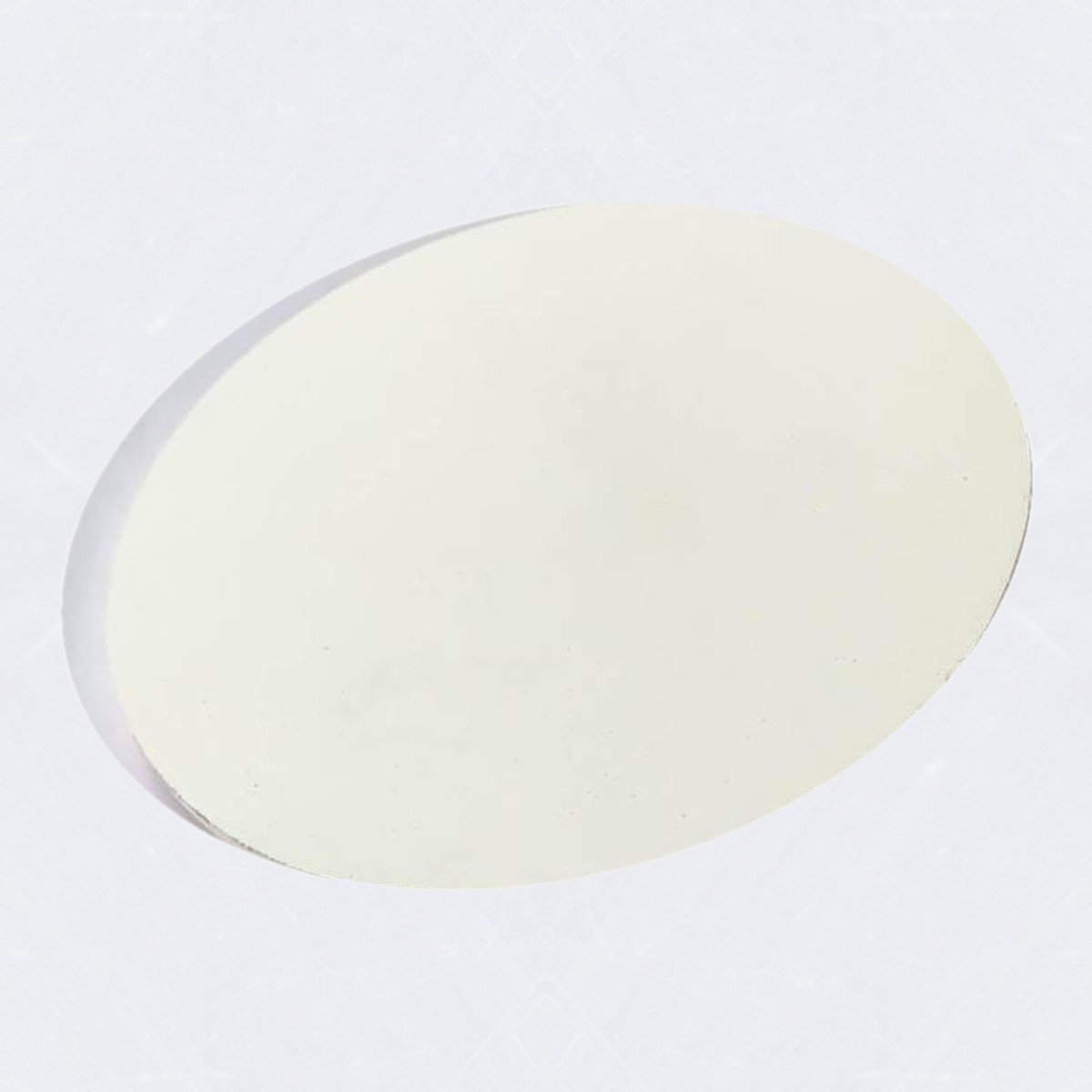
Titanium dioxide is the highest-index material in common optical coating use, which makes it the standard high-index layer in visible and near-IR filters. The catch is oxygen stoichiometry: a substoichiometric film absorbs, and the target is where that starts.
Specification
| Composition | TiO2 |
|---|---|
| Purity | 99.9–99.99% |
| Density | 4.23 g/cm³ |
| Melting point | 1843 °C |
| Form | Discs 2″, 3″, 4″, 6″, 8″ · plates to drawing · rotatables on request |
| Bonding | Indium or elastomer to Cu backing; bond coverage checked |
| Packing | Vacuum-sealed, foam-lined case with density and stoichiometry report |
| MOQ | 1 pc |
| Lead time | 20–30 working days |
What decides the film
- Stoichiometry is the specification — TiOx with x below 1.95 absorbs visibly.
- Targets are usually hot-pressed; density affects both index and scatter.
- For reactive processes, the gas loop matters as much as the target.
End applications
- Optical interference filters
- High-index layers in AR coatings
- Photocatalytic and self-cleaning films
- Dielectric layers in capacitors
Frequently asked
Why is my TiO2 film yellow or brown?
Oxygen deficiency. Either the target is reduced or the process does not supply enough oxygen; check both before changing the target.
Can you supply TiO2 with a stated stoichiometry?
Yes — the O/Ti ratio is reported on the certificate for optical-grade targets.
Related reading: targets for optical coatings · ITO vs AZO vs IGZO · all ceramic targets
Related resources
- Applications — where this material is used, by industry.
- Deposition methods — e-beam vs thermal, liner choice, pre-melt and defect fixes.
- Crucible fill calculator — how much charge fits in the liner.
- Film material calculator — material needed for a given thickness.
Reviews
There are no reviews yet.