
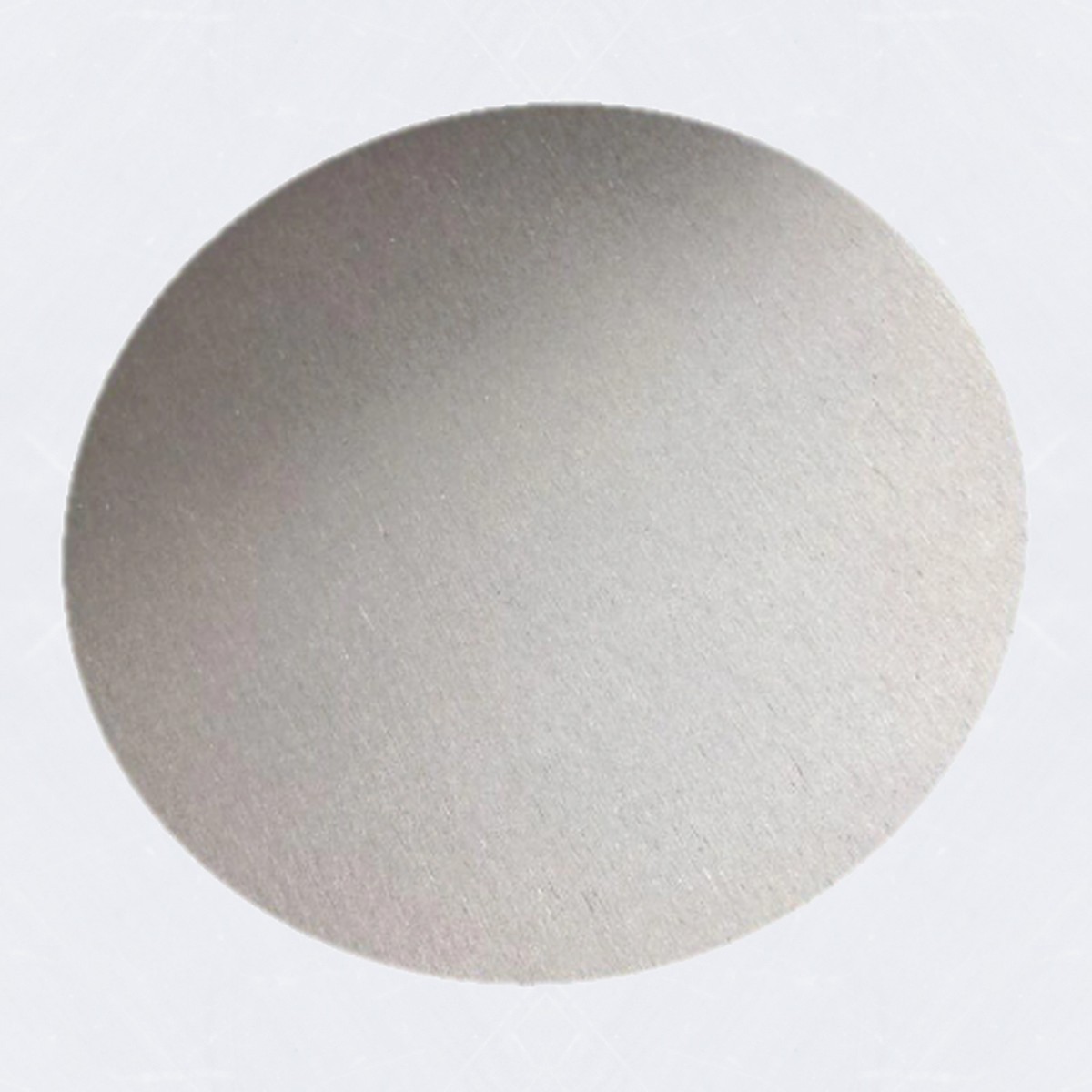
Sub-stoichiometric tantalum oxide targets are used for resistive switching layers in RRAM and memristor devices, and for optical films where a specific oxygen deficiency is wanted. The oxygen ratio is the product specification, not an impurity level.
Specification
| Composition | TaOx (sub-stoichiometric) |
|---|---|
| Purity | 99.9% |
| Density | ≈8.2 g/cm³ |
| Melting point | — °C |
| Form | Discs 2″, 3″, 4″, 6″, 8″ · plates to drawing · rotatables on request |
| Bonding | Indium or elastomer to Cu backing; bond coverage checked |
| Packing | Vacuum-sealed, foam-lined case with density and stoichiometry report |
| MOQ | 1 pc |
| Lead time | 20–30 working days |
What decides the film
- Oxygen ratio defines the switching behaviour — specify x in TaOx.
- Films are usually deposited amorphous and switched by forming voltage.
- Targets are made to a stated oxygen content, verified per lot.
End applications
- Resistive RAM and memristor switching layers
- Optical films with tuned absorption
- Diffusion barriers
- Neuromorphic device research
Frequently asked
Can you make a target with a specific Ta:O ratio?
Yes — TaOx is quoted against the x value you specify, and the ratio is verified on the certificate.
Is TaOx the same as Ta2O5?
No. Ta2O5 is the fully oxidised stoichiometric compound used as a dielectric; TaOx is deliberately oxygen-deficient for switching applications.
Related reading: targets for optical coatings · ITO vs AZO vs IGZO · all ceramic targets
Related resources
- Applications — where this material is used, by industry.
- Deposition methods — e-beam vs thermal, liner choice, pre-melt and defect fixes.
- Crucible fill calculator — how much charge fits in the liner.
- Film material calculator — material needed for a given thickness.
Reviews
There are no reviews yet.