
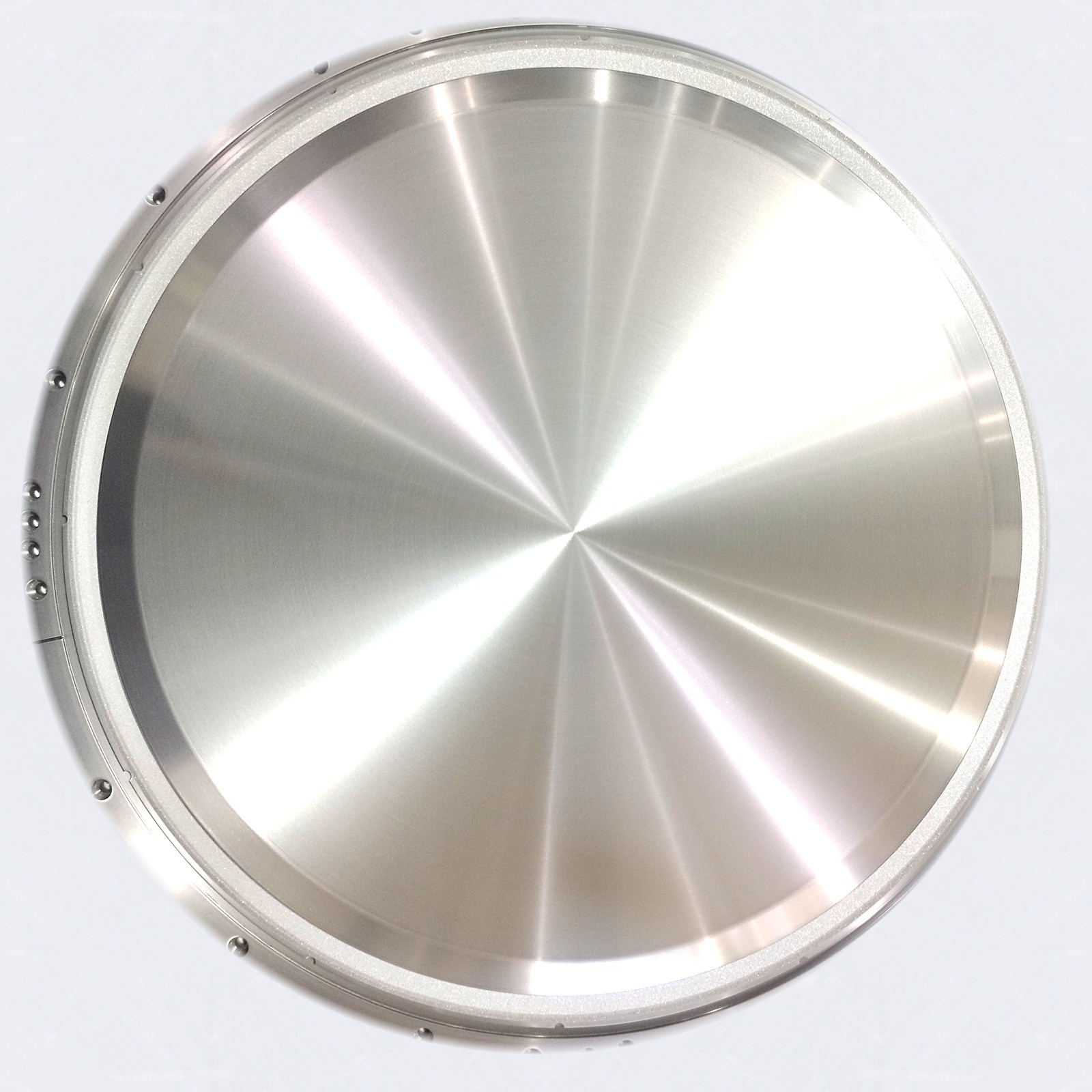
Titanium targets almost always make a thin layer — 5 to 50 nm of adhesion or barrier under gold, platinum or aluminium. At that thickness the film is entirely interface, so oxygen and nitrogen in the target, not the trace metal total, decide whether it sticks.
Specification
| Material | Titanium (Ti) |
|---|---|
| Purity | 3N5 (99.95%) – 5N (99.999%) |
| Density | 4.51 g/cm³ |
| Melting point | 1668 °C |
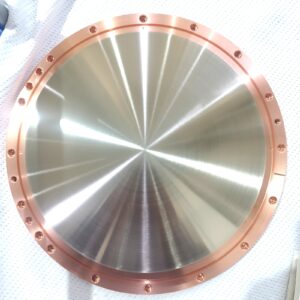
| Form | Discs 2″, 3″, 4″, 6″, 8″, 12″ · rectangular plates to drawing · rotatables on request |
| Grain / texture | Fine grain, controlled texture — stated on request |
| Bonding | Indium or elastomer to Cu / Al backing, bond coverage checked |
| Packing | Vacuum-sealed, foam-lined case with flatness record |
| MOQ | 1 pc |
| Lead time | 15–25 working days |
Sputtering notes
- Gas content (O, N, H) is the specification that matters; ask for it explicitly.
- Fine grain reduces arcing on the nodule-prone edges of a planar target.
- Titanium is a getter — a chamber that has just run titanium needs longer pump-down before an optical run.
End applications
- Adhesion layers under noble metals
- Diffusion barriers in semiconductor and MEMS
- Decorative and wear coatings
- Optical and getter films
Frequently asked
Why does my Ti adhesion layer fail?
Often oxygen in the target or an oxidised substrate. Both show up as a non-metallic film colour.
Is 5N titanium available?
Yes, 5N (99.999%) is our top grade, with gas content stated on the certificate.
Related reading: target specification guide · all metal sputtering targets
Related resources
- Applications — where this material is used, by industry.
- Deposition methods — e-beam vs thermal, liner choice, pre-melt and defect fixes.
- Crucible fill calculator — how much charge fits in the liner.
- Film material calculator — material needed for a given thickness.
Reviews
There are no reviews yet.