
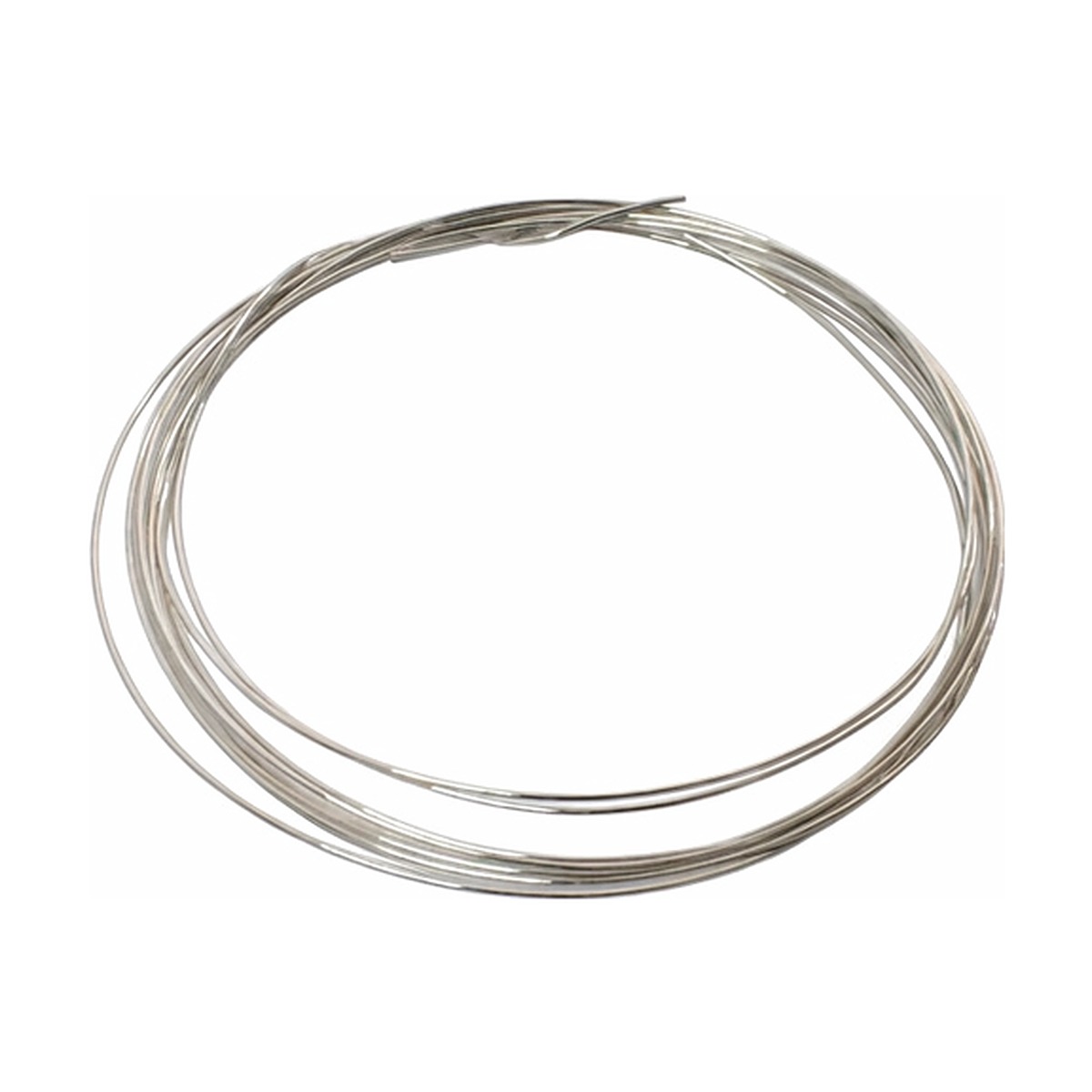
Platinum wire in 3N5 purity, drawn from 0.025 mm (1 mil) to 6.0 mm. Platinum is the standard material for high-temperature thermocouples and for electrodes that must not corrode, and it is one of the few metals that stays chemically inert at 1500 °C.
Specification
| Metal | Platinum (Pt) |
|---|---|
| Purity | 3N5 (99.95%) |
| Form | Wire |
| Dimensions | Ø 0.025–6.0 mm; coils or straight lengths |
| Density | 21.45 g/cm³ |
| Melting point | 1768 °C |
| Packing | Vacuum-sealed, argon flushed; spool or flat pack in a foam-lined case |
| MOQ | 100 g (samples from 10 g) |
| Lead time | 10–20 working days |
Tolerances and handling
- Platinum wire is supplied annealed; fine sizes are extremely soft and must not be tensioned.
- For type R/S/B thermocouples, specify whether you need the positive or negative leg — they are different alloys, not pure platinum.
- Recovery of used platinum wire is usually worth quoting.
End applications
- High-temperature thermocouples
- Electrodes for electrochemical work
- Evaporation and sputtering feedstock
- Laboratory and catalysis hardware
Frequently asked
Is your platinum wire pure Pt?
The wire is 3N5 platinum. Thermocouple legs are alloys (Pt-13%Rh for type R/S positive leg) and are quoted separately.
Can you supply 0.025 mm platinum wire?
Yes — 1 mil is available, annealed and spooled.
Related reading: all wire, foil and solder products · high-purity evaporation materials
Related resources
- Applications — where this material is used, by industry.
- Deposition methods — e-beam vs thermal, liner choice, pre-melt and defect fixes.
- Crucible fill calculator — how much charge fits in the liner.
- Film material calculator — material needed for a given thickness.
Reviews
There are no reviews yet.